Stalwart and Bulwark: a rock-solid and modern E-mail stack

On 12 November 2026, shortly before 17:00 UTC, Microsoft 365 began to fail worldwide and kept failing for most of two days: Outlook, Teams, and Copilot dark for users in more than 70 countries; hospitals back to paper records; and productivity losses estimated by the Anderson Economic Group at roughly seven billion US dollars (Wikipedia). The root cause was three problems that happened to stack: a latent defect in Microsoft's networking gateway servers, a change in traffic allocation, and maintenance that had reduced capacity. Nothing malicious, just ordinary operations at a planetary scale (CNBC). On 14 November the services were restored, followed by a phishing wave exploiting the confusion.
My inbox did not notice any of this: it does not live in Outlook. A caveat up front, in fairness: in my day job I am a government employee, and there I use Outlook professionally. That mailbox belongs to the institution, and moving it is not my call (Tactic: Render to Caesar); sovereignty at work is a different battle, fought over "public money, public code" and procurement, not over private servers. This post is about the private sphere, where the choice is actually mine. That private mail lives on a Rust program I run myself, fronted by a webmail I control just as completely. The two pieces of software behind it, Stalwart and Bulwark, are what this post is about, together with the quieter lesson from that week: self-hosted email is no longer a hobbyist compromise but a resilience decision. Lab-tested, not theorized: everything below runs in my own setup today.
The argument
Big platforms are function-rich, cheap per seat, and professionally operated, and for many organizations they remain the rational choice. But the more in-depth issue is architectural, not corporate: one system operated for everybody concentrates risk. A defect, a structural fault, or targeted sabotage lands everywhere at once, and hundreds of millions of people end up sharing one queue and one status page. Distributed systems fail differently: locally, partially, independently. Sovereignty is a decision about blast radius: if my mail server fails, one person is offline, and that person can inspect, fix, roll back, or migrate.
The old counter-argument was that self-hosting means stitching together Postfix, Dovecot, a spam filter, a webmail, a calendar server and a file server. That argument is obsolete.
Stalwart: mail, calendars, contacts and files on one AGPL server
Stalwart is an open-source mail and collaboration server written in Rust. Its Community Edition is free software under the AGPL-3.0; a commercial Enterprise Edition adds operational tooling for large, multi-tenant deployments, while both editions implement the same protocols and core features, per the project's own comparison. The code has passed an independent security audit (report public), and development was partly funded by NLnet's NGI program, European public-interest money.
The feature list reads like a self-hosting wish list:
- Mail: JMAP, IMAP4rev2/rev1, POP3, SMTP, and ManageSieve for server-side filters.
- Collaboration: CalDAV, CardDAV, and WebDAV, plus JMAP for calendars, contacts, sharing, and file storage. The usual office communication stack lives on one server.
- The ironic one: Microsoft Exchange support, meaning MAPI over HTTP for classic Outlook for Windows, EWS for Outlook for Mac and Apple Mail, and ActiveSync for phones. The very client whose outage caused this post could talk to my server natively.
- Transport hygiene: DKIM, SPF, DMARC, ARC, DANE, MTA-STS, and automatic key rotation: deliverability config in one place instead of six services.
- Anti-spam and anti-phishing built in: rules, statistical and DNS-blocklist filtering, phishing protections, and an optional AI classifier for any OpenAI-compatible endpoint or local Ollama: spam filtering with your own model, under your own roof.
- Encryption at rest: register a per-user public key (OpenPGP or S/MIME), and Stalwart encrypts stored mail (docs).
JMAP first, IMAP for everyone else
JMAP (RFC 8620/8621) is IMAP's modern successor: one HTTPS session, batched operations in a single round trip, and pushed state changes instead of polling. Stalwart is a first-class JMAP server, which is why the client below feels instant.
But sovereignty you have to force on people is not sovereignty: Stalwart also serves IMAP4rev2, so Thunderbird, Apple Mail, K-9, and friends connect exactly as they always have. Nobody in your household or team has to change a client they like.
Bulwark: a webmail that does the server justice
Bulwark is an open-source webmail client built for Stalwart, licensed under the AGPL v3, written in TypeScript on Next.js, and developed in the EU. Behind one login: mail with threads, full-text search, and a unified multi-account inbox; a calendar with invitations and editable task lists (VTODO), vCard address books, and Stalwart's file storage with previews and sharing; office documents can be edited in place once you connect Collabora or ONLYOFFICE (Bulwark docs). That unified inbox, one calm stream across all my accounts, is quite simply the best implementation I have seen in any webmail client (and I tried many).
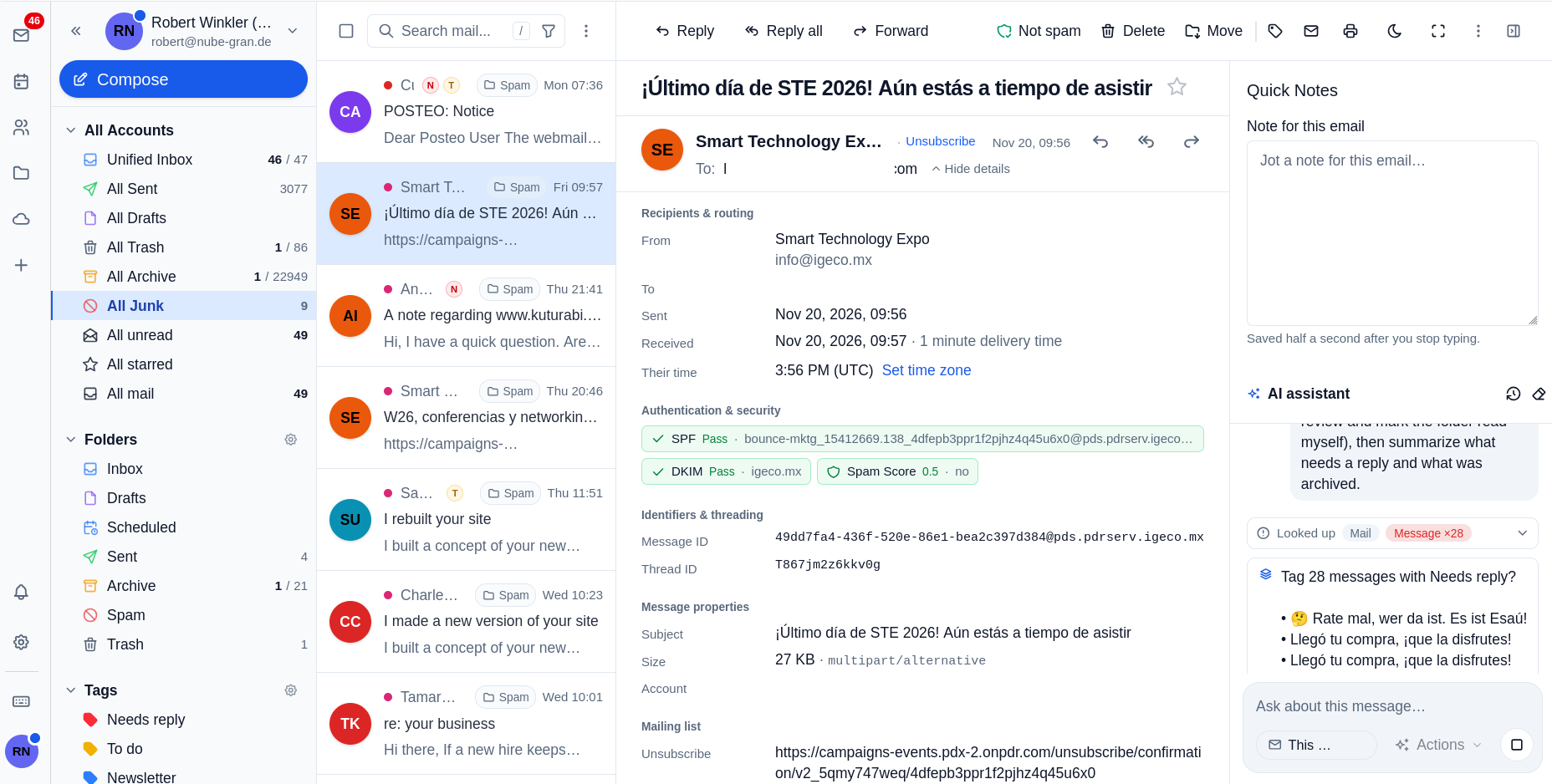
It ships as a Node.js service with an admin console and plugin marketplace, or as static Bulwark Lite. It also subscribes to external calendar feeds by URL and imports vCard contacts, so data from, say, a Nextcloud can come along. The plugins are where it gets practical:
- PGP True End-to-End (community plugin): sign and encrypt outgoing mail, and automatically verify and decrypt incoming OpenPGP mail, with private keys kept encrypted in the browser.
- S/MIME (by Bulwark, verified author): sign, encrypt, verify, and decrypt with X.509 certificates imported from PKCS#12, in the browser.
- Nextcloud (by Bulwark): attach files from your Nextcloud, send big attachments as share links, and save mails and attachments back.
- AI Assistant (by Bulwark): a chat beside your mail, calendar, contacts, and files, working with any OpenAI-compatible endpoint (Ollama, vLLM, and others) or Anthropic's API, so you pick the model and jurisdiction; mine points at Mistral's EU-hosted API. It summarizes, drafts, and rewrites replies; translates; and can file, tag, archive, or move messages on request.
The assistant works strictly on demand; nothing goes to any model until you ask, and incoming mail is not auto-classified in the background yet. Deterministic triage is still the job of sieve filters and rule-based tagging.
The legacy proxy: no migration cliff
What about accounts you cannot move to a self-hosted server? That is what bulwarkmail/legacy-proxy (AGPL-3.0) solves: a translation layer that speaks JMAP to clients and IMAP, SMTP, ManageSieve, CardDAV, and CalDAV to whatever already holds your data. The mail stays where it lives, nothing is migrated, and any RFC 8621 client sees the account as native, push included. The same bridge covers contacts and calendars: my Nextcloud's CardDAV and CalDAV collections show up in Bulwark as native, live, and writable address books and calendars, so I keep working immediately with the contacts and appointments synced there (the bridge does not carry VTODO tasks yet, those live in Bulwark's own task lists). My pre-migration mail accounts run through it too, next to my self-hosted mailbox in one inbox.
State of the art
Both projects are excellent, and both are young:
- Release velocity: Stalwart reached 1.0 only in late October 2026 (heise took a close look, noting the speed benchmarks are the project's own measurements), and Bulwark is even younger. Read the upgrade notes, and do not bet regulated production workloads on either without a test instance; for individuals and small teams, the polish is already remarkable.
- Deliverability is your job now: Stalwart turns SPF, DKIM, and DMARC into one coherent configuration, but a fresh IP's reputation still has to be earned.
- Trust boundaries: the server is independently audited; the PGP plugin is community code, and the legacy proxy lacks a third-party audit. Review what you install, especially around keys.
- Backups and monitoring are yours. That is the deal.
- AGPL-3.0 in practice: running unmodified Stalwart or Bulwark triggers no source-disclosure obligation; offering a modified version as a network service does.
It was never about never failing
Nothing in this stack is infallible. The difference is geometry: a planet-sized platform has planet-sized failure modes, where sabotage or a structural fault is everyone's problem at once, while a distributed landscape of self-hosted and federated systems fails locally and independently, one operator at a time. When my server misbehaves, the blast radius is one person (or the group of accounts I created), the logs are mine, and the fix is a rollback away. Digital sovereignty is not the absence of problems; it is the difference between infrastructure you watch and infrastructure you own.
That alternative is now worth taking seriously: install Stalwart, deploy Bulwark, and keep your existing accounts in the room through the legacy proxy. Your inbox will not thank you. It will simply keep working.
One last footnote, to close the loop: if you subscribe to this blog's newsletter, the emails you receive are delivered by the very Stalwart server this post describes. This blog lives up to its argument. And if you want to compare notes, write to me at robert@nube-gran.de, PGP-encrypted if you like.